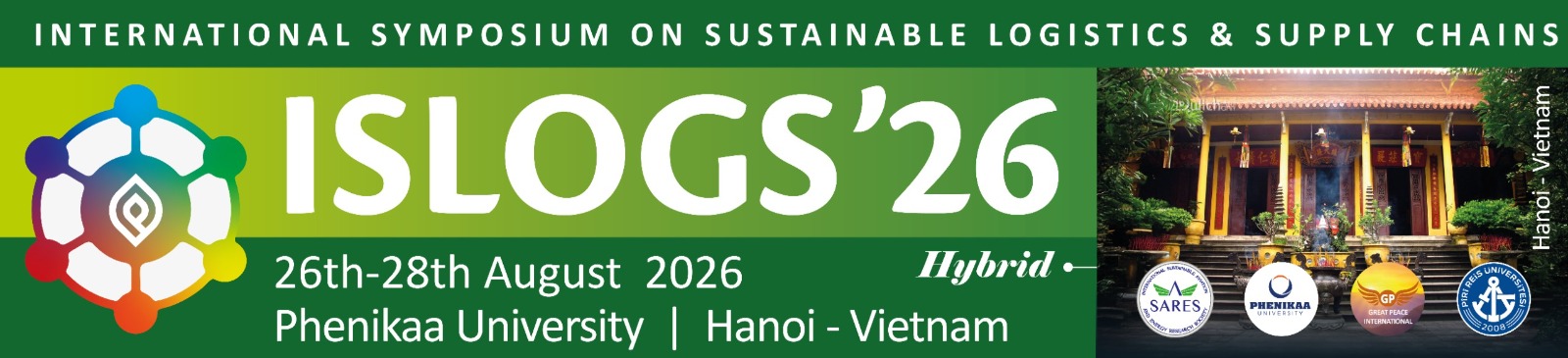
About ISLOGS
Symposium Objectives
ISLOGS 2026 aims to serve as an international platform for advancing research, innovation, and practical solutions in logistics and supply chain systems, with a strong focus on sustainability, digital transformation, and operational resilience. The symposium brings together academics, industry professionals, and policymakers to address current challenges and future opportunities shaping global logistics ecosystems.
By providing a global forum for knowledge exchange and interdisciplinary cooperation, ISLOGS 2026 seeks to promote smarter, cleaner, and more resilient logistics systems while contributing to sustainable economic development worldwide.
Symposium Format
By providing a global forum for knowledge exchange, innovation, and interdisciplinary collaboration, ISLOGS 2026 aims to foster smarter, cleaner, and more resilient logistics and supply chain systems, while contributing to sustainable economic growth and long-term societal development worldwide.
Symposium Topics
Sustainable Supply Chain Management
- Sustainable supply chain design and management
- Circular economy and closed-loop supply chains
- Green logistics and environmental performance assessment
- ESG (Environmental, Social, and Governance) integration
- Sustainable sourcing and supplier selection
- Carbon footprint analysis and Life Cycle Assessment (LCA)
Logistics Operations and Transportation
- Green transportation and alternative fuels
- Intermodal and multimodal transportation systems
- Last-mile delivery and urban logistics
- Smart mobility and intelligent transport systems
- Sustainable warehousing and inventory management
- Cold chain logistics
Digitalization and Emerging Technologies
- Digital transformation in supply chains
- Artificial intelligence and machine learning applications
- Blockchain for transparency and traceability
- Internet of Things (IoT) in logistics
- Digital twins and simulation technologies
- Big data analytics and decision support systems
Resilience, Risk, and Uncertainty
- Supply chain resilience and robustness
- Risk management and disruption mitigation
- Post-pandemic supply chain strategies
- Geopolitical risks and global trade dynamics
- Agile and flexible supply chains
Reverse Logistics and Waste Management
- Reverse logistics systems and networks
- Waste reduction and recycling strategies
- Remanufacturing and product recovery
- Sustainable packaging and materials management
Industry Applications and Case Studies
- Retail and e-commerce logistics
- Food and agri-food supply chains
- Healthcare and pharmaceutical logistics
- Energy and industrial logistics
- Humanitarian and disaster logistics
Optimization and Decision-Making
- Mathematical modeling and optimization techniques
- Simulation and scenario analysis
- Multi-criteria decision-making (MCDM)
- Network design and routing optimization
Social Sustainability and Policy
- Ethical supply chains and social responsibility
- Labor conditions and human rights
- Public policy and regulatory frameworks
- Sustainability reporting and performance metrics
Future Trends and Innovations
- Autonomous vehicles and drone delivery systems
- Electric and hydrogen-powered transportation
- Smart cities and urban logistics innovation
- Net-zero and carbon-neutral supply chains
- Platform economy and shared logistics
International Promotion Partner
ISLOGS’26 is pleased to be featured on the Great Peace International platform as part of its international promotion activities. This collaboration supports the global dissemination of the symposium, enhances its international visibility, and encourages broader academic and industry participation.
We thank Great Peace International for their valuable support and contribution to the promotion of ISLOGS’26.
Promotion Page:
https://www.great-peace.com/islogs-2026